
Context
The vertical transportation systems manufacturers face a severe crisis caused by an aging workforce combined with a sharp decline in incoming novice technicians due to the perceived dangers of the job. Crucially, the industry suffers from critical safety challenges, including fatal field accidents occurring each year. A high percentage of these incidents happen because a technician forgets foundational protocols.
Because, getting access to live systems for novice technician training can take even months due to the operational demands, a scalable, high-fidelity VR safety training simulator was required to pitch directly to enterprise accounts.
Requirement
I took ownership of the project to research, design and develop the technical architecture, environment designing, system programming, and instructional design to build a functional, immersive safety training simulation live prototype. My tasks included developing a robust system logic capable of mirroring complex machinery operations, designing immersive pedagogical structures that force active learning, creating diegetic guidance mechanisms, and prototyping automated scoring tools to evaluate user compliance without manual supervision.
Solution
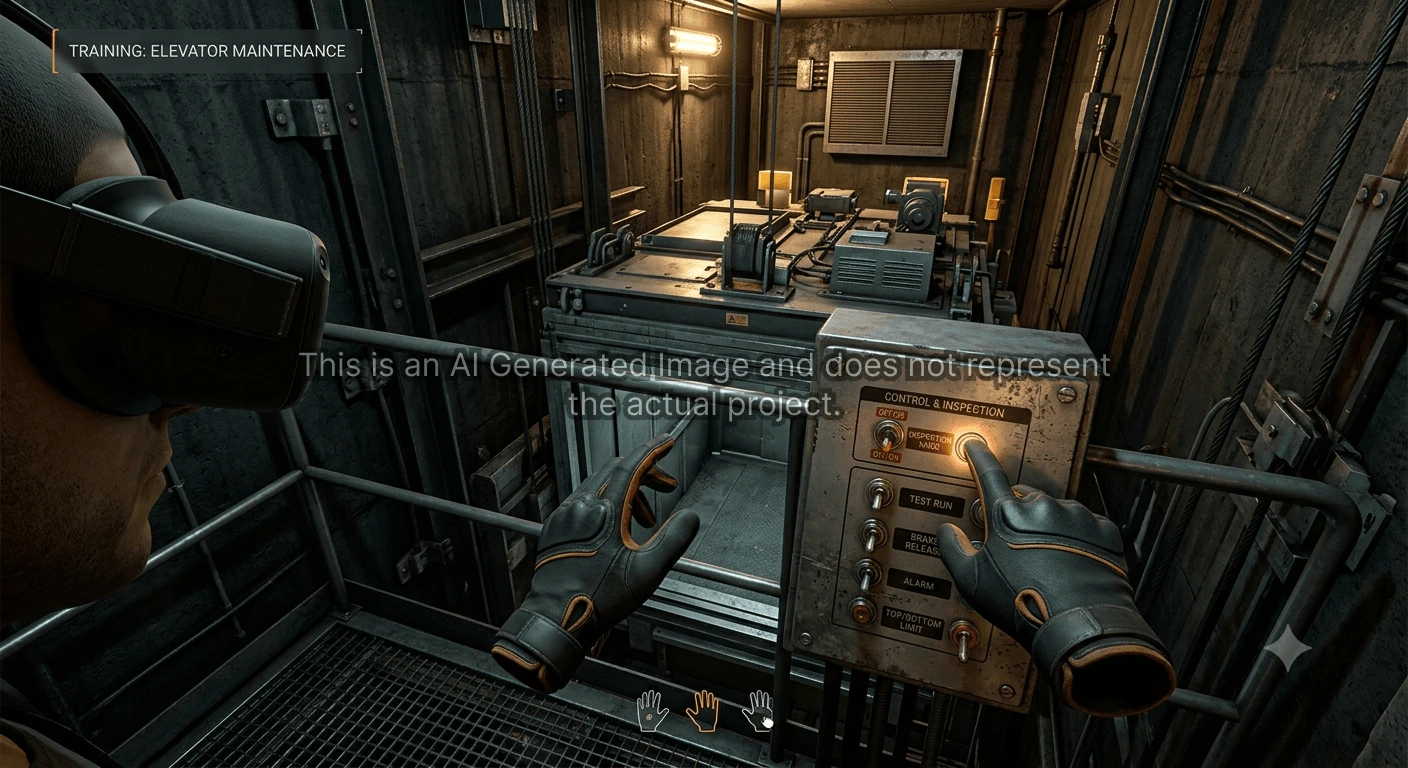
Traditional corporate training models that rely on passive video consumption or simple linear instruction lists were completely bypassed. Instead, a “learning by doing” loop was built into the application architecture. Trainees were placed inside a virtual replication of a standard field service day. They were required to actively consult technical reference sheets, take digital notes, and execute complex mechanical steps inside the simulator. The system was designed to allow users to make unguided errors, letting them experience the immediate physical consequences of safety mistakes within a safe, simulated environment.
To support an interactive environment, the entire mechanical systems were built from scratch using clean Object-Oriented Programming (OOP) State Machine patterns in C# within Unity. Every single sub-system—down to the each individual button, functional systems, mechanisms were fully programmed and the hazard work environment was visualised in high-realism to ensure realistic mechanical behavior and environment immersion. This allowed the entire system to respond dynamically based on the exact sequence of user actions.
To eliminate bulky text boxes and abstract menus that break immersion, an NPC (Non-Playable Character) “Master Technician” was integrated into the scene to provide realistic, voice-guided support to novice trainees. This diegetic voice design acted as an in-game mentor for the trainee and functioned as a live narrator for training.
Working in ShapesXR, a companion automated assessment module was prototyped. This module tracked industry-standard Safety Key Performance Indicators (KPIs) and hazard identification metrics. By designing branching logic paths and clear programmatic fail-states, the system could automatically evaluate a trainee’s safety compliance. Enabling pre-site simulation training runs without need expert technician supervision.
Outcome
The initial high-detail prototype delivered an immediate business win, securing a major new multi-national industrial account for the BU and earning widespread praise from business unit leadership. The success of the pilot expanded the project’s budget and scope, leading to the assignment of a dedicated cross-functional team (comprising 3D modelers, UI designers, and specialized developers) to scale visual fidelity and integrate advanced hand-tracking pipelines. Ultimately, the simulator proved that automated, state-driven spatial applications could accurately replicate dangerous enterprise environments, eliminating the need for expensive, live human instructors to monitor preliminary training runs while successfully mitigating real-world operational risk.